

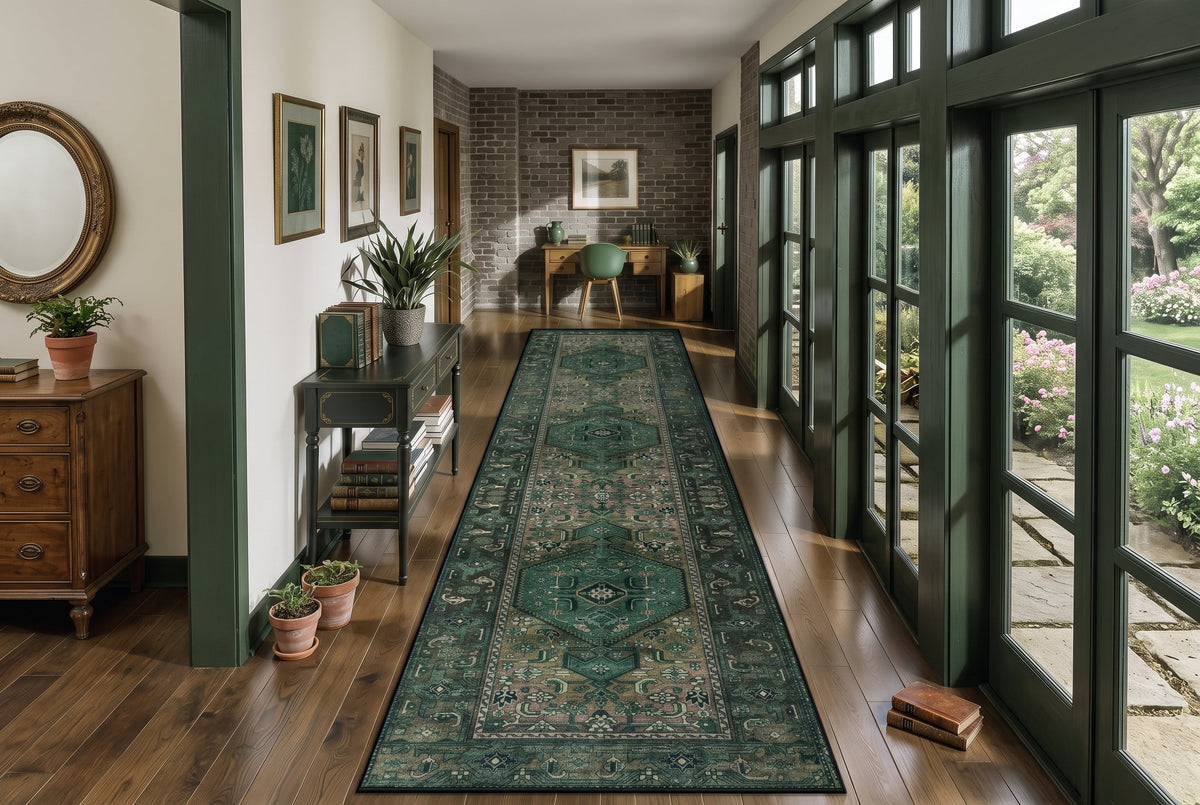
When we curate textiles for our homes, our attention naturally gravities toward the surface. We admire the intricacy of a faded medallion pattern, run our fingers across the plushness of a low-pile weave, and imagine how a rich vintage palette will harmonize with our living room furniture.
Yet, the true structural integrity and everyday performance of a rug are determined by what lies underneath.
In many homes, an unstabilized rug is a silent source of daily friction: a runner that bunches up in the entryway, corners that stubborn-curl into trip hazards, or a living room centerpiece that shifts dangerously underfoot when children or pets race across the room. Addressing these micro-frustrations requires moving past superficial decor and examining the materials engineering beneath the surface.
The Engineering of Stability: Why Traditional Backings Fail
To understand why modern performance textiles are evolving, we must first examine why conventional rug backings frequently fail in active households:
-
The Decay of Industrial Latex: For decades, mass-market manufacturers relied on cheap synthetic latex or chemical glues to anchor rug yarns. Under everyday humidity, temperature fluctuations, and repeated friction, these traditional adhesives rapidly oxidize and embrittle. Over time, they harden, crack, and dissolve into a white, powdery residue—leaving the rug unanchored while marring the underlying floor.
-
The Inadequacy of Mesh Pads: Separate PVC mesh anti-slip pads are often recommended as an after-market fix. However, these floating pads tend to bunch up independently of the rug, require tedious trimming, and frequently react chemically with hardwood finishes, causing irreversible discoloration.
A truly enduring home textile does not rely on secondary pads or degrading adhesives. It integrates structural stability directly into its DNA.
TPE Innovation: The Science of Thermoplastic Elastomer
At SERISSA, resolving the friction between beauty and utility led us to integrate TPE (Thermoplastic Elastomer) into our backing engineering.
1. What is TPE?
Thermoplastic Elastomer is a high-performance polymer material that combines the elastic resilience of traditional rubber with the processing stability of advanced thermoplastics. Unlike natural rubber or cheap synthetic latex, TPE contains no volatile organic compounds (VOCs) or harsh chemical plasticizers.
2. Exceptional Grip Mechanics
TPE exhibits high surface friction and thermal stability. When placed against smooth surfaces such as sealed hardwood, engineered plank, laminate, or glazed tile, the micro-textured TPE surface creates a mechanical vacuum-like grip. It resists horizontal shear forces, keeping the rug firmly locked in place without leaving sticky residues or damaging floor finishes.
3. Washing Machine Compatibility & Thermal Resilience
Because TPE is a thermoplastic material engineered to withstand mechanical stress and water exposure, it retains its structural elasticity across hundreds of wash cycles. Unlike latex—which disintegrates or warps when exposed to water and agitation—TPE remains completely flat, flexible, and intact after machine washing, eliminating the dreaded curling edges that plague lesser washable rugs.
4. Eco-Friendly and Odorless
Unlike traditional rubber backings that emit strong chemical off-gassing, high-grade TPE is non-toxic, odorless, and 100% recyclable. It provides a clean, breathable foundation that supports healthy indoor air quality.
Peace of Mind for Active Homes
In a home where life actually happens, safety cannot be an afterthought.
When children sprint down a hallway, or pets execute sharp turns during playtime, an unanchored rug turns into a dangerous launchpad. For aging family members or guests, even a slight shift or curled edge can lead to serious slips and falls.
By engineering a high-grip, low-profile TPE backing directly into our low-pile vintage collections, SERISSA creates an "invisible safety net." The rug stays flat against the floor plane, offering a seamless transition that accommodates heavy foot traffic, vacuum cleaners, and robotic floor cleaners without catching or shifting.
Marrying Vintage Elegance with Structural Safety
True luxury in modern interior design is never fragile—it is empowering. It allows you to invite rich, historical storytelling and vintage aesthetic warmth into your sanctuary without policing your family’s movement.
By pairing timeless design logic with the material science of non-toxic TPE backing, we ensure that your home remains not only aesthetically inspiring, but deeply secure from the ground up.