

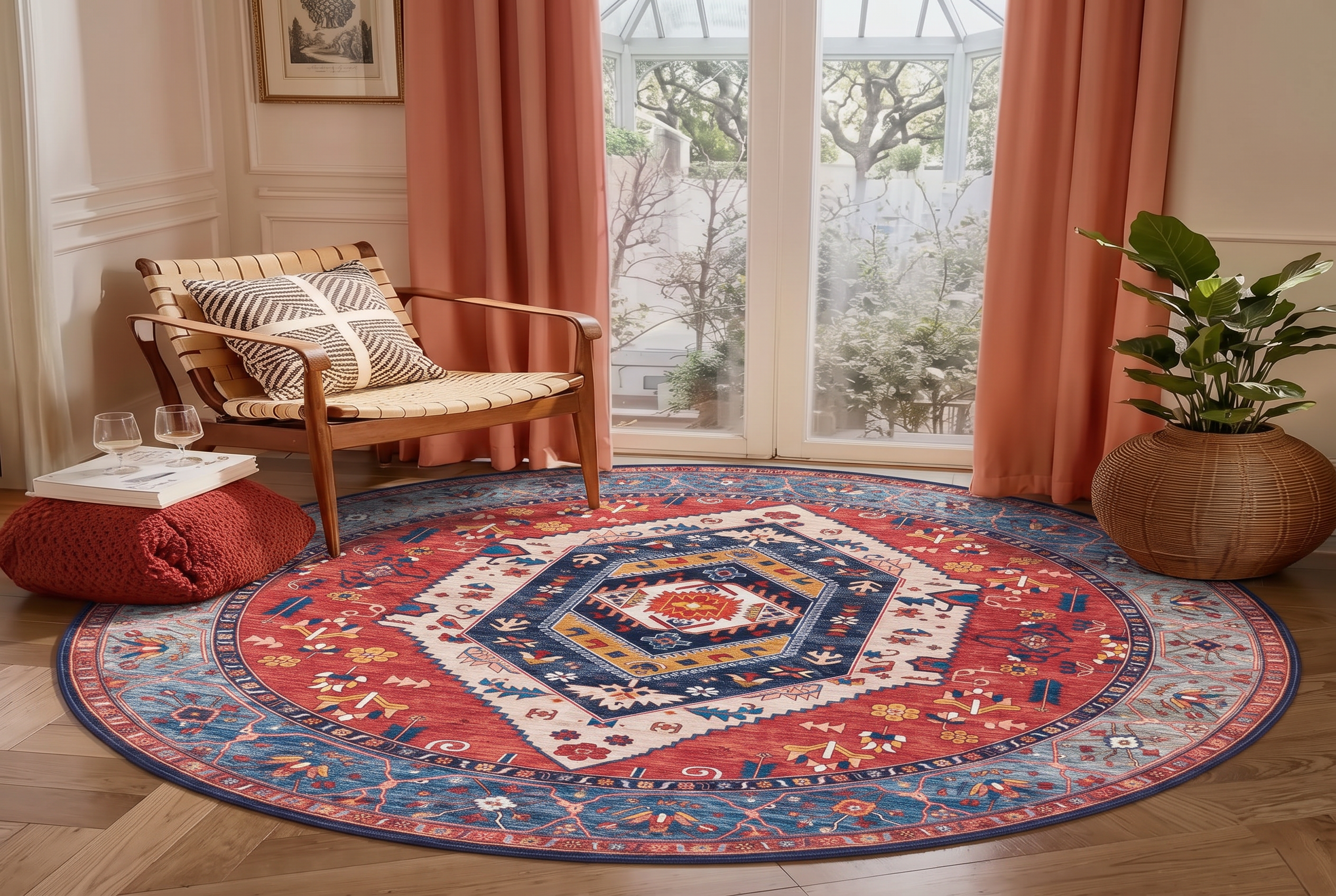
In the contemporary home, the mantra of "less is more" often dominates. We gravitate toward clean lines, neutral palettes, and an absence of clutter—a visual exhale that feels modern and intentional. Yet, there is a recurring tension in the work of the most thoughtful interior designers: the persistent, magnetic appeal of a vintage-inspired rug within a minimalist sanctuary.
Why do we invite the ornate, the storied, and the complex into spaces defined by simplicity? The answer lies in the dialogue between contrast and narrative.
The Architecture of Contrast
Modern minimalism often risks feeling sterile—a space that is perfectly ordered but emotionally silent. This is where Contrast Design becomes vital. When you place a rich, vintage-patterned rug on a smooth, monochromatic floor, you are not merely adding a decorative element; you are introducing texture and depth.
The juxtaposition is intentional. The sharp, architectural lines of modern furniture find their warmth in the softened, historical geometry of a rug. It is a visual balance where the "new" provides the structure, and the "vintage" provides the soul. A space without this contrast often feels like a showroom; a space with it feels like a home.
The Narrative Power of Patterns
Every vintage pattern is a fragment of a story—a language of motifs that have traveled through centuries of craftsmanship. Whether it is the intricate floral scrolls of a traditional medallion or the bold, symbolic geometry of a tribal weave, these patterns carry a sense of history.
In a minimalist room, where the walls are muted and the furniture is understated, a patterned rug becomes the storyteller. It speaks of far-off places, of artisanal traditions, and of the human touch. When you walk across such a piece, you are stepping onto a narrative. You are reminding yourself that while your home reflects the clarity of the present, it is also connected to a broader, richer lineage of art.
Creating Your Own Dialogue
Integrating a vintage-inspired piece into a modern space does not require abandoning your minimalist aesthetic; it requires a curatorial eye.
-
Respect the Scale: In a minimalist room, let the rug be the primary point of visual interest. Allow it to occupy the space it deserves, acting as an anchor for your seating area.
-
Balance the Palette: Choose a rug that shares a color language with your room—perhaps a vintage blue that echoes a cool-toned wall, or a warm terracotta that grounds a room filled with light. This ensures that the contrast feels considered, not jarring.
-
Focus on Tactile Integrity: A vintage look should not feel fragile. At SERISSA, we believe that the beauty of a pattern is most enjoyed when you aren't afraid to live with it. Our designs aim to capture the soul of historical textiles through modern, resilient fibers that feel soft, plush, and effortlessly manageable underfoot.
The Beauty of the "Lived-In"
Ultimately, the marriage of vintage patterns and modern minimalism is about the beauty of the "lived-in." It is a move away from the static perfection of a magazine spread toward a home that feels evolving, thoughtful, and personal.
When you choose a piece that carries the weight of history into your modern sanctuary, you are doing more than decorating. You are choosing to live in a home that acknowledges the clarity of the present while honoring the color of time.